Noob Questions

Hi all,
I am new to this site, didnt know it existed to be fair!

I am in the uk and am building a competition circuit R32 skyline gts-t.

My main focus is to remove a lot of the weight.So far i have:

-10 square meters of fibreglass finsihing cloth
-10kgs of polyester resin
-fibreglass roller
-lots of cheap brushes
-buckets and jugs for measuring and mixing
-some normal car wax

I am attempting to make a fibreglass mold for the boot/rear hatch on my car which is a straight forward shape. Am i using the right stuff, or do i need epoxy resin as i cant find it anywhere at a good price. If i need epoxy can anyone name cheap suppliers in the uk, preferably in the midlands.

I have waxed the boot 5 times now and applied 2 layers of cloth with lots of resin, i then rolled out the bubbles and ensured it all went see through with resin.

This has dried now, but should it set from normal room temperature or does it need heat(i have read somewhere that i might need heat on this to cure) to cure?

I now need to get something stronger on the back of this which i am waiting for delivery on which is chopped strand matt.

Once the mold is mad (if it works) should i just fibreglass inside it or do i need to wet & dry it smooth and wax it again? also got ova release agent coming.

Thanks John

Uh oh.
Did you apply a tooling gelcoat to the surface before laying the fiberglass?
Do not use CSM! It absorbs a lot of resin, which makes it heavy. It’s not very strong, and can easily cause the mold to warp.
Use a couple layers of 6oz glass, and then several 10oz layers. The mold should be about 3 times the thickness of the parts you want to make.

I did not apply a tooling gelcoat, will the mold not come off of the plug now? I hope it does!!

I have the csm now, should i just use it anyway for now just to get experience with the fibreglass or just rid of it and get some 10oz glass?

thanks john

Hello John,

Whoa, I think you’ve got a bit ahead of yourself there…
You need to start with a gel coat then two coats of tissue so your mold surface will be smooth, your part should come off, but the surface will be a bit coarse and maybe have some air pockets in it around the detail. The parts you make will only be as good as the plug and the mold! Any defects will annoyingly be repeated.

As you are still trying to learn the basics I would start on something a lot easier, a good book for starters is ‘Competition Car Composites’ Read it.

I’m a beginner too and have only been making parts (and cock ups!) since last Autumn, getting better though by using the above recommended methods.

Whereabouts in the UK are you based?

Sorry, I don’t mean to contradict you, but I’ve had far worse warping with the woven glass than I did with CSM, I can’t see the problems with using it for mould making? I’ve never had any. Polyester seems more stable in winter to me, we’ve had some crazy shapes come out (and gone in the bin) just lately as the weather is now warmer here.
I was advised that Epoxy warps less, a bit expensive for molds though!

I always thought the glass CSM should be the first few layers after the gel coat, because it lay in the corners better, and not cause bridging. Then after a few layers are built up, you would add your woven fiberglass.

Is this wrong, or does everyone do it different.

I just ordered a bunch of CSM for my Datsun molds.

I would like to add, you should get some PVA release for your release agent. Use it while also waxing the mould.

my book is on the way, should be here anyday! goes with my competition car ekectrics & competition car aerodynamics. Good series!

I am located in Northampton, whereabouts are you?

The mold is the old boot and it has been filled and smoothed with filler, to a shiny finsih.

Gel coat is now on the way i have pva release en route to with some 600gm woven glass. Also fancy some acetone to clean the brush’s, rollers and buckets etc.

Gonna lay up some csm on top of the 2 layers of tissue matt, or should i do some more tissue matt? wil;l the csm strands show through the tissue or as it has set should it be ok?

Thanks John

p.s thanks for all other replies, i shall update you with pics when i release the mold!!

Thanks John :slight_smile:

:eek: here is my working environment, i’m sure not as flashy as most but its all abckyard/garage work for me, gotta start somewhere!!


Hope this comes of the plug!!

Thanks John


And some of my work!!


sorry for last 3 threads not making sense i can only put 3 pics up at a time!!

But you get the picture(s) lol

Thanks John

Hello John,

Hmmm pics, we like lots of pics…

I’m up in Leeds, so a bit of a way from you.

I’m afraid the mold you’ve made will be scrap, but you can get it off and learn instantly from it, you may want to extend the next one at the edges to carry the CSM when you are laying up. You would be better off practising on a piece of melboard (Contiboard) or a pane of glass maybe, but I know what it is like to want to make something worthwhile and that if it comes out ok you can actually use. :rolleyes:

Here’s how I would tackle the job (from my experience of making basic molds for body panels):

First ensure the plug is perfect, I would coat it with 2 pack primer and flat it off to make sure. Leave it to harden fully in the sun(!) for a good while, the layup of the mold might affect it and cause it to wrinkle or stick.

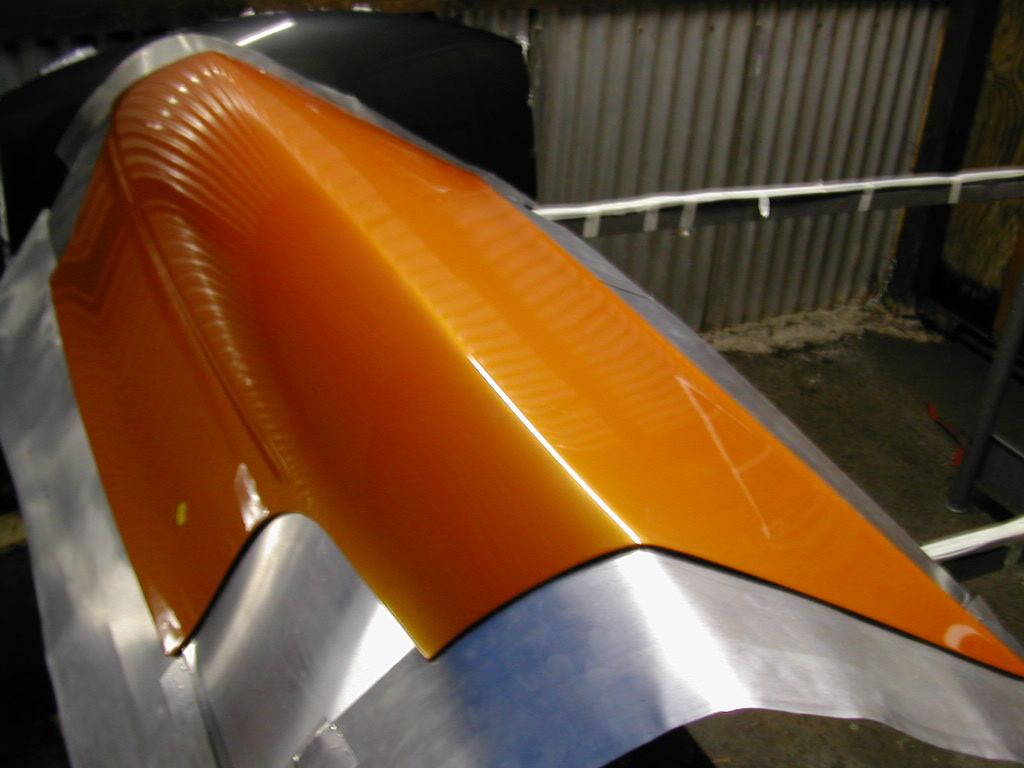
Extend bonnet edges with double sided tape, cardboard/aluminium strips and aluminium tape

Apply several coats of wax, buff, dry then coat with PVA (some don’t, mainly the Pros, but I like the safety marging it gives)

Coat with Gel coat, leave overnight, should be tacky not sticky.

Apply 2 coats tissue with resin, this will stop the coarser strands of the CSM from showing through the mould face.

Apply numerous coats (about 5 - 7) of CSM, don’t build up too many at once in summer, it will get hot and could warp - just two at once, let cool down, then carry on.

Allow to harden fully, break off carefully, light your pipe, stand back and admire your work. :smiley:

This is just the very basics, have a good read of your new book first and let us know how you get on, good or bad!

Martin.

Like Evodelta says, you will make things a lot easier for yourself the next time round if you add some flanges around the edge of the part you are trying to mold.these run off areas are used to seal down your bagging film to if you are infusing but make things a lot easier even if you are just doing a hand lay up.This pic shows the alloy flanges I used while making the mold for a subaru bootlid.you also have to add clay around the edge of the part to get a nice rolled edge on the finished part.Hope this helps.I am in the UK also,N Ireland to be exact.Keep at it and you will get there.Theres lots of good info on this site to help you out.

doh!! whats gonna be the best way to remove the mold?

Will it peel off or will it crack to bits?

If it comes off in 1 piece could i fill any impurities, sand and spray to use as a mold or is it totally fubard?

Thanks John

It should come off ok, (well, that depends on how well you prepped the 'lid!) but yes, it’s scrap. Try again I’m afraid. :eek:

Yeah, heres something I’m going to try, and I’m sure it’s been used before.

Go get a roll of aluminum valley flashing at a hardware store.

It’s cheap enough, comes in different sizes, easy to work with, did I mention cheap!!

http://www.homeandbeyond.com/aluminum-roll-flashing---valley.html

Looks like a good buy, we can get this stuff overhere:
http://www.ukindustrialtapes.co.uk/glazing/gp01.asp

I use it to stick on the temporary extention pieces, it’s also good if you find that you need to build up the thickness of them so they are nearly level with the surface of the plug (if it’s a body panel), you can just lay on a couple more lines and then stick on some of your aluminium flashing pieces.

what`s the thickness of this aluminum valley ?

looks like not all is lost, them mold nearly came off, gonna get the rest off tomorrow, what do you recommend for fibreglass that is stubborn to remove from plug? pva release agent?

will get pics up for morning or afternoon , whenever ready really.

Thanks John

A strong solvent such as Acetone or Cellulose thinners, or more probably some heat will help - heat gun or boiling water.