My infusion nightmare

Hi guys,
I have same never ending problem with my resin infusion.

I try to make samples on small glass mirror. I use Frekote 770 NC release agent (tried also PVA). I use about 3 layers of carbon twill (about 5-6oz fabric). Than I use one layer of peel ply. I use Enkafusion as flow media on top of the peel ply. Simple inlet tube and outlet covered with peel ply. All bagged with high quality bag, sealing tape. I can hold 29" of vacuum for at least one day, so there are really no leaks. I use high quality epoxy resin with viscosity about 400-500cps (also tried another epoxy with 300cps). Resin was degassed at 29" for 15 minutes.
Problem is that I still have lot of pinholes in the intersections of tows in fabric. I don’t have any idea what the hell I’m doing bad :frowning:
After infusion everything looks very good, but after a while I can see lot of micro bubbles in the flow medium and on the peel ply. I try to slow the infusion by deforming inlet tube, so resin can penetrate fabric better without locking any bubbles.

Any ideas?

Mike

dont put flow medium over the whole surface. probably your infusion happens too fast and the air doesnt have time to escape…

There is no such thing as an infusion being “too fast.” That’s like trying to slow down the resin as it goes through the tubing from the container to the bag!
When is the resin feed line being clamped off? Do you have pictures of the setup?

I dont have pictures of the setup. But imagine small rectangle (6"x3"), enkafusion on all surface,Simple inlet and autlet tube without spiral tubing. I will make pictures next time. I clamp it off whet about 70% of the piece is infused. Im not sure but maybe its caused by my resin. But two different brand of resin with same problem?
I read about special degassing when you drop piece of scotch bride into the container and than vacuum degas. Scotch bride is bubble nucleation promoter. Maybe I will try it.

I’ve always had luck with either stopping the flow media 0.5-1.0" away from the end of part, OR add a long delay line of just peel ply before the vent. This way the carbon can fully infuse, inside and out.
Besides that, the layup sounds good, especially if you have no pressure rise for a day! (you DID shut OFF the vacuum while testing for leaks, right? :wink: )
Which resin? Epoxy or VER/PER? When you degas, does it bubble up, and then drop, or do you take it out when it is still foamy?

Yes TET, it can be too fast…top can be infused, and the bottom can have dry spots…especially with large tows, or unidirectional (stupid Oxeon!!) The resin will take the path of least resistance (flow media), and cut off “flow” under the part as it racetracks around.

I use a bigger fridge compressor as a vacuum pump. Lot of people think that is a stupid way, but I’m able to pull 28,8" and I’m at 1000 feed under sea level! After I pull max, I shut down vacuum pump. Clamp inlet tube (before vacuum reservoir-resin catch pot with mounted gauge). I’m able to hold it like that for a day with no visible (on gauge) vacuum decrease.

I use only epoxy resins. Old one has bubble foam on top after 10 minutes of degassing. I was unable to fully degas it. New one was with few bubbles on top that didn’t pop (15min degassing).

I found that when I clamp off inlet tube after infusion, some bubbles appear from nowhere during curing. They can be easily seen in the inlet tube. May it be caused by resin reaction or what?

Also Im bit disappointed with enka fusion flow media. I have the thinnest one, but I found that it don’t make good pressure on whole surface of the part. As a result, the fibers are not pressed beautifully. Also it causes some sort of spring back. After everything is cured, the final surface of the part is not flat as the mirror glass which was used as mould. It is shiny, but whole surface is ,waved,. I know that its very thin layup, but I don’t think it is normal, because I didn’t had this problem before.

Is it possible to pull too much vacuum?

With polyester yes, if you pull too much vacuum the resin will start to boil. Not sure what about epoxy… Im experimenting with degassing right now…

I only know from the few infusions i have done that there was always some gas bubbles trapped in the flow medium or peel ply… usually never the composite laminate unless I had an air leak, and you state you had no air leak.

How many feet of hose is there between your clamp and resin bucket? There will be some air in that tubing, so what I always tried to do was get the clamp as close to the resin bucket end of the hose as possible. This eliminates some trapped air from the hose before the clamp is released. Also make sure you have more than enough resin in the bucket so you don’t draw air into the line. It sounds obvious, i know.

Stir your epoxy or resin with a round dowell stick… less bubbles than a flat stir stick produces. Also stir slowly and try not to whip bubbles into the mix.

Okay so I was playing with degassing. Result is that I’m not able to fully degas resin. It always has small bubbles on top and few small inside. I’m limited in time because of short geltime. Tomorrow I will try slower hardener.
I think I introduce air by mixing. How to mix resin perfectly and not make bubbles?

I have learnt a lot about the more technical side of infusion recently from tets advice etc.100% perfect every time now.here are Some of the things I have found that can make a vast difference to getting the fabric wet out properly.same as some other people I used to stop my flow mesh a couple of inches before the end of the part.I had some tiny dry spots this way.I now run it past the part to give the resin a better chance of wetting out the whole laminate,not just the top layer.I can still see air moving out of the carbon after the flow front has passed.Just because the resin has flowed past the top of the laminate does not mean it has infused perfectly all the way down to the gelcoat.Remember the resin is flowing through the mesh which is on top of the layers of carbon.I find that the higher viscosity resins (thicker) take more time to wet out the laminate thoroughly that a low viscosity one.I have infused over 100 parts so far this year and this works perfect for me

all that degassing thing sounds weird to me… i ve tried several epoxy resins and all of them as soon as they are stirred, are almost bubble free, and even if they have bubbles, one minute later they have risen to the surface and popped. this, with infusion resins, or even thicker layup resins…

Both resins are clear after careful mixing, that’s ok. But if you infuse with them, and they are under vacuum, then you will see how many bubbles you have in it. Simple test for this. Just ,infuse, tubing. Clamp inlet and let it cure under vacuum. All that bubbles will expand.

Look at the picture. Clear epoxy on left where the inlet is and after tube was clamped, bubbles appeared on right-vacuum side.

Just a thought, but It looks like the bubbles are being drawn in through a hole caused by the clamp?

use a vacuum infusion resin. There is a solvent in that resin that is outgassing/boiling.

2Evodelta: No, there was no chance. Clamping was perfect.

2snocutt: That is maybe the problem…

Still running lot of different tests…

Mike

infusion can make grown men cry. thats why i stopped :stuck_out_tongue:

Im not too far to stop trying :smiley:

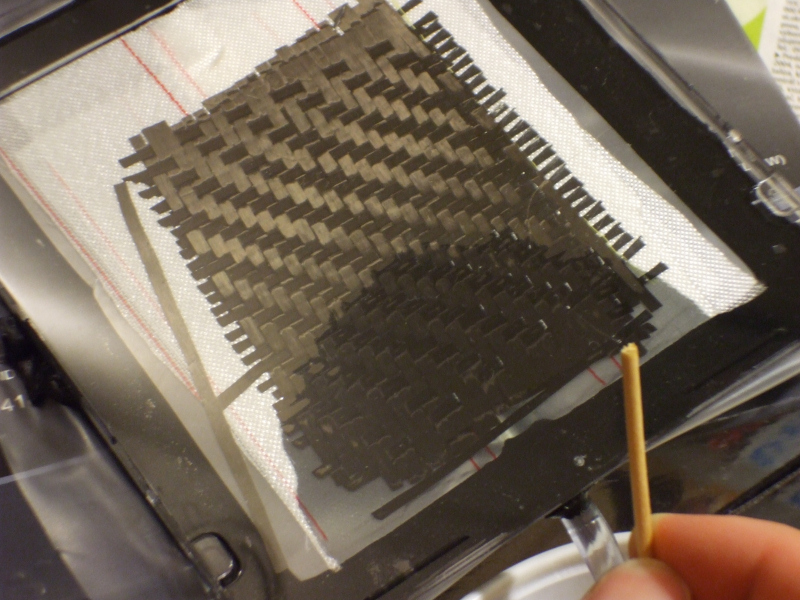
Okay, so today I made a new type of test. I was wandering why I didn’t think it out like this before. I made infusion on a piece of clear plastic (CD cover) and upside down. Standard setup, frekote, 3layers of carbon twill (160g/m2), used only 3 layers of peel ply without any flow media, sealing tape and bag. Pulling 28,5" all the time. Infusion was really slow of course. Everything was perfect, perfect wetting and filling with resin as you can see on first and second pictures. Whole piece was infused without any visible void. Than I clamped feed line. After few minutes when ,de-bleeding, was running I saw small spots in the fiber intersection. After few more minutes they were bigger and bigger (picture 3). The result can be seen on the fourth picture.


So what the hell is that? I think its resin problem. Maybe its vaporizing under vacuum or what. Or trapped vapors in resin will start to expand after feed line is clamped when resin is under bigger and bigger vacuum.

Are you sure it was holding the same level of vacuum after clamping the feed line?
Where was the vacuum line located?