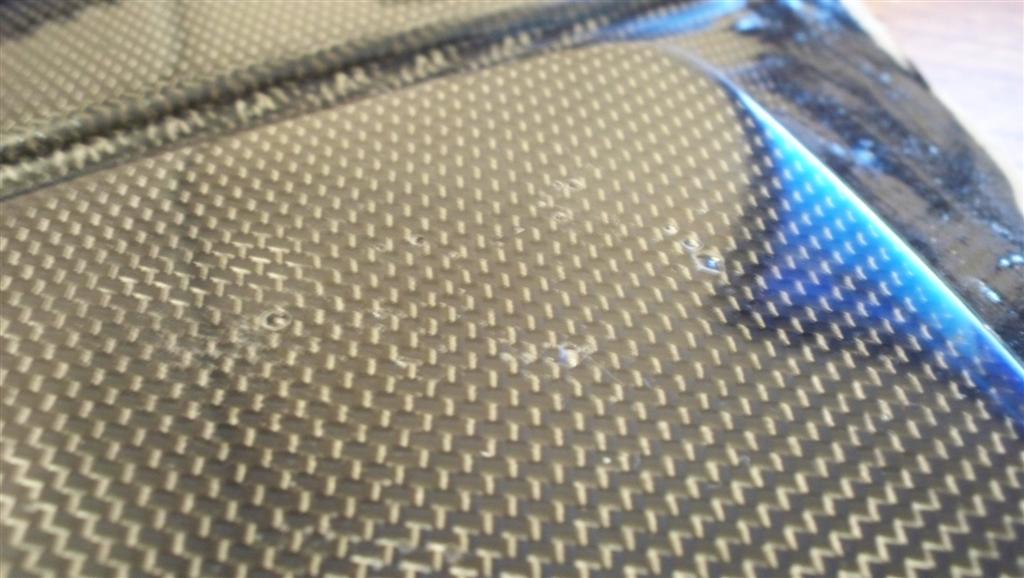
carbon probs - wet/bagging

This is my first carbon layup and I ran into some probs. Wondering if anyone can help. The corners seam to be cloudy where there is excess resin. Also there seamed to be random dry spots that I can touch the raw carbon. I still only using peel ply/breather cloth as my perferated film hasnt arrived yet. Epoxy resin, under vacuum for around 3.5 hours. Ive taken some photos, what could be causing this?

I am always in very high humidity where I live.

#1 rule in composite part design: Avoid tight corners.

You can get around this by using multiple pieces of material. Also, are you working the material into the mold with partial vacuum? Don’t count on the bag pulling the material into tight spots.
Is your resin fully cured at room temp in 3.5 hours? The pump should run for the duration of the cure, which is usually 8 hours or more at room temp for epoxies.

From what I have learned here, and also in my own experiments is where you had the cloudy spot with too much resin it may have been the bag that was not loose enough to move and press down against the carbon and put pressure on it tightly to the face of the mold. If the vacuum bag itself was taught, and wasn’t alowed to press down as far as it wanted to, the carbon fabric could have been above the face of the mold a few mm causing there to be a thickness of resin there.

The air pockets however I am not sure of, I have been working on things without vacuum so far so my experience may deter the true issue with that.

Question, when you say it was on vacuum for 3.5 hours do you mean the pump was running for that amount of time or just the amount of vacuum pressure applied was constant for 3.5 hrs and pump was off?

I lost my data sheet for my resin so I have no idea cure time. But when i turned the pump off it was def hardened, maybe not fully cured though. Ill try longer for the next one. I am pushing the baging into the corners, but I didnt leave myself any slack, so next time im going to leave some excess bag and try and work it a bit better in the tight corners. I could try and cut a piece that will only just fit into the part and not touch the flanging at all, that might stop the bridging.

pump was on for 3.5 hours, after i turned it off pressure dispersed after a few minutes, but the breather/peel ply stayed, ie semi hardened and was staying in the corners like in vacuum. I think your right about the bridging, the carbon wasnt close to the mold surface but I put loads of resin in before the carbon to try and compensate.

What are you running for a pump setup? I am going to start vacuum bagging this month with similar parts (more on the flat side to start). Any information you can share with me will be helpful to me, and the community. What you are running for Hg in vacuum pressure etc.

Dont know what HG means. I am only very new to vacuum too, but Ive been making molds for a while now.

I read a few articles on beginning vacuum baging and they all say its ridiculously easy to make your own pump, so thats what I did. I didnt want to jump into this with my wallet wide open. I bought a $10 tire inflater, removed the plastic case, epoxy glued and sealed a plastic hose fitting around the cylinder intake and cut off the tire connection. These pumps run off 12v cig lighter plug. I took out a 300w computer PSU from an old computer collecting dust. A 12v rail has max 10amps which is what the pump needs to work at max. I jerry rigged the on/off wired on the mobo loom to always be on (controlled by switch at back of PSU) connected the yellow 12v + and a black - to the pump.

It works quite well actually. Dont expect to get good vac on a hood mold or something but for small things it does the job well. The thing is the PSU has 3 unique 12v 10amp rails, So i can go buy another 2 pumps for $20 link the vac up parallel which should be plenty for a hood sized mold. I dont know how much more vac infusion needs to work though.

When I got the other two pumps im going to mount everything inc a little vac manifold in a sounds proofed wooden box. Should be pretty neat, might do a how-to on it or something.

Also I tried for ages to find a valve for my vac bagging, my fiberglass supplier says they dont sell them anymore because there are so many equivalents out there for much cheaper and easier to obtain… but they couldnt direct me where to go to get one for some reason. I went to a local plumbing store but they just gave me a weird look. I thought about it for a while and I really didnt need a valve, the clear tubing I use is like 20c a meter, I just put excess breather coth in one corner, put the end of the tube in about an inch, make sure the end is inside breather cloth so it doesnt clog and seal the tube in the bag with a bit more tacky tape. A valve will probably get more air flow but this way seems to be working fine for now.

mmm thats a post-n-a-half. I hope I was some help.

Hg is the elemental sign for mercury, asking how much vacuum you are pulling it is equated to inches of mercury.

I dont understand how mercury has got to do with vacuum.

Inches of MERCURY. inHg is what most gauges read.

The old way to measure vacuum was long tube inverted upwards that was filled with mercury and they measure it in inches as it was very long!

Flow benchs for ported racing heads still use a version of it to this day!

a two part pressure mold would work well for those two parts.

Did you use clear gel coat on the mold for the parts?

What type of resin?

Yes i realise mercury is on vac gauges, but I dont understand why, how does vac effect mercury?

Just run of the mill epoxy resin. I didnt clear coat the mould first, but I want to. Maybe you could help me with some Qs. Is there a specific clear coat I should use into molds i.e. epoxy 2pak clear only? Do i leave extra cure time for the clear before resin/CF/vacuum? I have a gal of acrylic clear here, do you think I could try this, maybe an overnight dry will do? Dont these clear coats contain wax which released to the surface when cure/dry just like polyester resins? Will this effect bonding to my resin at all? Any other useful information before I clear coat the mould would be good.

Im interested in the second part mold press you mentioned. Can you expand on that?

2 part molding:

Take your hand, make a fist.
Take your other hand, and push down and squeeze the fist.

Basically, you take one mold with good flanges, place something in the part area (some people use a finished part, others use a layer of wax, to look like the part), and layup a mold on top of that. Separate the 2 parts, and you have a matching mold set with space in the cavity for the part. Calc’s need to be done to make sure you make the wax part the right thickness, so you squeeze enough resin out (or don’t make it so thick there is extra resin)

vacuum doesn’t effect mercury, mercury was simply used as the liquid in a long tube to give us an idea of the pressures that that we are achieving relative to the atmosphere. Mercury is the heaviest liquid there is and is the most reasonable way to measure, we could have used a tube filled with water…but since water has much less mass it would have needed a much longer tube that was unfeasable, somehting like 30+ft long if i recall correctly. Therfore mercury was used and all that was needed since it’s a much more dense liquid is a tube that is much chorter, which is reasonalbe for use as a measuring tool. If you don’t understand it still jsut try wiki or searchig, it’s really not a big deal to understand the physics behind it but just to realize that the more theoretical “inches of mercury” that you are able to pull up ward in a tube against gravity the more vacuum you have (actuall it’s the amout of mercury the open atmosphere can puch up the tube but this might just confuse you more and ignore it).

ok thanks for the explanation 20.

Yeah thats a good idea, i might play with that. I think a small amounts of plasticine pressed into the small side wall and layup over that will do the trick. Do I clamp this on over the vac bag? Or no vac at all with this system?

normally, no vacuum, and no bag (however, release film might work well to make sure the part doesn’t stick to mold…you will have resin squeezing out)
However, yes you can bag it, and press the top the mold on. You can also use the top mold part as a caul plate IN the vac bag.
OR you can seal the mold and use it as an RTM mold (using pressure to inject the resin, and not use vacuum to pull it through)
SO many ways to do a two part mold.